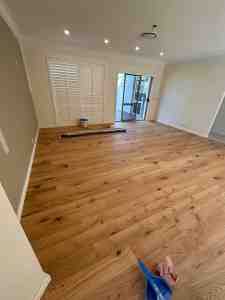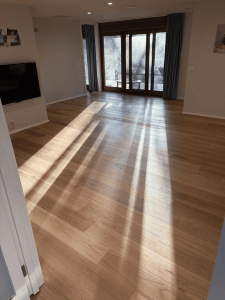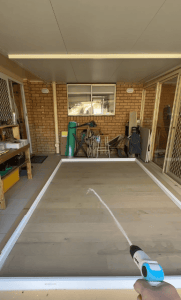
When choosing engineered timber flooring for your home, selecting the timber species, colour, plank size and surface finish is only part of the decision. Another important consideration is how the flooring should be installed.
Should you install engineered timber as a floating floor or glue it directly onto the subfloor?
Both installation methods are widely used in Sydney, but they differ significantly in installation costs, floor stability, moisture resistance, subfloor preparation, repairability and long-term performance.
At Floorplan Studio, we work with both installation systems. Based on our practical flooring installation experience, we would like to explain the advantages and disadvantages of each method, including some common misconceptions that homeowners may have.
1. What Is a Floating Floor?
A floating floor is a flooring system in which the floorboards are not mechanically or adhesively fixed to the subfloor.
Instead, the individual floorboards are connected to each other, forming a continuous flooring surface that rests on the subfloor under its own weight.
As temperature and humidity change throughout the year, the entire flooring system is allowed to expand and contract. This is why expansion gaps around walls, doorways, kitchen cabinetry and other fixed structures are essential.
Laminate flooring and hybrid flooring are typical examples of products specifically designed for floating installation.
Engineered timber flooring, depending on its construction and locking system, can also be installed as a floating floor.
2. What Is Direct Stick Flooring?
Direct stick flooring, also known as glue-down flooring, is an installation method in which floorboards are bonded directly to the subfloor using a specialised flooring adhesive.
Unlike floating floors, each floorboard is individually secured to the substrate, creating a more stable and integrated flooring system.
Common flooring products suitable for direct stick installation include:
-
Engineered timber flooring
-
Solid timber flooring, where the product and substrate permit
-
Glue-down luxury vinyl plank flooring
-
Commercial vinyl flooring
It is important to understand that laminate and hybrid flooring specifically designed for floating installation should not be glued directly to the subfloor.
Restricting the natural expansion and contraction of these products can result in joint failure, deformation, buckling and other flooring problems.
Many engineered timber flooring products, however, are suitable for both floating and direct stick installation.
This brings us to the main question: which installation method is better?
3. Floating Engineered Timber Flooring: Advantages and Disadvantages
Lower Installation Costs
One of the biggest advantages of floating engineered timber flooring is its relatively low installation cost.
The installation process is simpler, requires fewer installation materials and generally takes less time than direct stick installation.
In many residential flooring projects, the installation labour cost of floating engineered timber flooring can be approximately half that of direct stick installation.
This makes floating installation an attractive option for homeowners working within a limited renovation budget.
The Benefits of Flooring Underlay
Floating engineered timber flooring is typically installed over a layer of underlay.
Depending on the type and specification of the underlay, it can provide several benefits:
-
Reducing moisture transmission from the subfloor when an appropriate moisture barrier is incorporated.
-
Providing thermal insulation.
-
Reducing impact noise and vibration.
-
Improving underfoot comfort.
-
Improving acoustic performance in residential apartments.
Floating installation was particularly common in older engineered timber flooring projects across Sydney, including many homes completed before 2010.
However, despite its affordability and relatively straightforward installation process, floating engineered timber flooring has several limitations.
Higher Requirements for Subfloor Flatness
One of the biggest challenges with floating flooring is its sensitivity to subfloor irregularities.
Because the floorboards are not fixed to the subfloor, uneven areas underneath the flooring can cause vertical movement when people walk across the surface.
This movement may result in:
-
A bouncing or hollow feeling underfoot.
-
Squeaking or creaking noises.
-
Excessive stress on the locking system.
-
Separation between floorboards.
-
Premature joint failure.
For this reason, proper subfloor preparation and floor levelling are particularly important when installing floating engineered timber flooring.
What initially appears to be a cheaper installation method may become considerably more expensive if extensive subfloor levelling is required.
Greater Vulnerability to Water Damage
Although engineered timber is generally more dimensionally stable than traditional solid timber, it is still a natural timber product that responds to moisture.
When a floating timber floor is exposed to excessive water, moisture can penetrate through the joints and become trapped underneath the flooring.
As the timber absorbs moisture and expands, the interconnected flooring system may develop problems such as swelling, cupping, buckling or lifting.
Because the floorboards are not individually bonded to the subfloor, excessive expansion can affect a relatively large section of the flooring.
Floating Engineered Timber Flooring Can Be Difficult to Repair
Contrary to popular belief, replacing an individual damaged floating engineered timber floorboard is not necessarily easy.
There are two common connection systems used in floating engineered timber flooring.
Click-Lock Engineered Timber Flooring
Click-lock engineered timber floorboards are mechanically connected through a specially designed locking system.
If a damaged floorboard is located in the middle of a room, the conventional replacement method often involves dismantling the flooring from one side of the room until the damaged floorboard is reached.
This can involve removing skirting boards, moving furniture and temporarily dismantling a large section of otherwise undamaged flooring.
Specialised local replacement techniques may be available for certain products, but they are not always practical or approved by the manufacturer.
Tongue and Groove Engineered Timber Flooring
Another common floating installation method uses traditional tongue and groove (T&G) floorboards, with PVA adhesive applied inside the grooves to connect adjacent boards.
In this system, the floorboards are not glued to the subfloor, but they are glued to each other.
Replacing an individual damaged floorboard without affecting the surrounding boards can therefore be extremely challenging.
Even if the damaged board is successfully removed, hardened PVA adhesive remaining inside the tongue and groove profiles can be difficult to clean.
The surrounding joints may also be damaged during the removal process, making the replacement technically demanding and relatively risky.
4. Direct Stick Engineered Timber Flooring: Advantages and Disadvantages
Higher Installation Costs
Direct stick engineered timber flooring is generally more expensive to install than floating flooring.
The additional costs primarily come from specialised timber flooring adhesives, adhesive application, more intensive installation labour and, where required, compatible primers and moisture management systems.
Professional glue-down installation also requires a higher level of technical expertise.
However, the additional investment provides several important benefits.
Greater Floor Stability and a More Solid Feeling Underfoot
One of the most noticeable advantages of direct stick engineered timber flooring is the stability of the finished floor.
Because each floorboard is bonded directly to the subfloor, vertical movement is significantly reduced.
The flooring generally feels more solid and produces less hollow noise when walked on.
A suitable flexible timber flooring adhesive also helps manage the natural expansion and contraction of the timber, reducing excessive movement across the flooring system.
For homeowners looking for a premium timber flooring experience, this solid feeling underfoot is often one of the strongest reasons to choose direct stick installation.
Improved Moisture and Water Damage Resistance
Direct stick installation can provide better dimensional stability when engineered timber flooring is exposed to changes in humidity or accidental water exposure.
As each floorboard is individually bonded to the subfloor, the adhesive helps restrain excessive movement and reduces the likelihood of widespread lifting or buckling.
A properly specified adhesive and moisture management system can also help protect the flooring against moisture transmission from the substrate.
This does not mean that glue-down engineered timber flooring is waterproof. Prolonged water exposure, flooding and excessive subfloor moisture can still cause serious damage.
Nevertheless, direct stick installation can offer better resistance to certain moisture-related flooring failures compared with floating installation.
Direct Stick Flooring Can Sometimes Be More Economical
This may sound surprising, particularly after discussing the higher installation cost of direct stick flooring.
However, in real-world flooring installation practice, the most expensive installation method is not necessarily the most expensive overall flooring solution.
In some older Sydney homes, achieving the subfloor flatness required for floating flooring can be technically challenging and costly.
Floating flooring relies heavily on the flatness of the underlying surface to minimise vertical movement and protect its locking system.
Direct stick engineered timber flooring, on the other hand, can be more forgiving of certain minor subfloor irregularities because the floorboards are individually secured to the substrate.
Depending on the condition of the subfloor, the flooring product and the adhesive system, direct stick installation may reduce the amount of floor levelling required.
The savings in subfloor preparation can sometimes offset the additional adhesive and installation costs.
Of course, flooring adhesives are not a substitute for floor levelling. The subfloor must still meet the applicable manufacturer requirements for flatness, strength, cleanliness and moisture conditions.
This is why we always recommend evaluating the total flooring installation cost rather than simply comparing installation rates per square metre.
Individual Floorboards Are Often Easier to Replace
Another common misconception is that glue-down timber flooring must be more difficult to repair because it is permanently bonded to the subfloor.
In practice, the opposite can often be true when replacing an individual damaged floorboard.
Because the surrounding floorboards are independently secured to the subfloor, a professional flooring installer can carefully cut out the damaged board, remove the remaining adhesive, prepare the substrate and install a replacement board.
There is generally no need to dismantle the entire flooring system from the edge of the room.
Although the replacement process requires professional skills, it can be more localised and less disruptive than repairing a floating engineered timber floor.
This is an important advantage when considering the long-term maintenance of a premium timber floor.
Large-Scale Flooring Removal Is More Difficult
While individual floorboard replacement can be easier, removing an entire direct stick timber floor is a different story.
Because every floorboard is bonded to the subfloor, large-scale removal can be labour-intensive, time-consuming and expensive.
Specialised flooring removal equipment may be required, followed by mechanical grinding to remove residual adhesive and prepare the subfloor for the next flooring installation.
If you are considering another major renovation in 10 or 20 years, the future removal cost may be worth taking into consideration.
This is one area where floating flooring has a clear advantage.
Higher Requirements for Professional Installation
Direct stick engineered timber flooring requires more than simply applying adhesive and laying floorboards.
The installer needs to understand:
-
Subfloor moisture assessment.
-
Substrate strength and surface preparation.
-
Adhesive selection and compatibility.
-
Primer and moisture barrier requirements.
-
Adhesive application and open time.
-
Timber expansion and contraction.
-
Expansion gaps and finishing details.
Incorrect adhesive application or inadequate subfloor preparation can lead to bonding failure, hollow spots and other long-term flooring problems.
Choosing an experienced and professional flooring installation team is therefore particularly important when investing in glue-down engineered timber flooring.
5. Direct Stick vs Floating Engineered Timber Flooring: Side-by-Side Comparison
| Comparison | Floating Installation | Direct Stick Installation |
|---|---|---|
| Installation cost | Lower | Higher |
| Installation complexity | Relatively simple | More technically demanding |
| Installation speed | Generally faster | Generally slower |
| Underlay | Typically required | Generally not required for standard direct stick systems |
| Subfloor flatness | Highly sensitive to irregularities | More forgiving of certain minor irregularities |
| Floor levelling cost | Can be higher depending on the subfloor | May be lower in certain circumstances |
| Underfoot feeling | Slightly floating or hollow | Solid and stable |
| Vertical movement | More noticeable on uneven substrates | Significantly reduced |
| Expansion and contraction | Movement across the floating system | Excessive movement better restrained |
| Water damage resistance | More vulnerable to widespread buckling | Generally better dimensional stability |
| Individual board replacement | Often difficult | Often easier and more localised |
| Complete flooring removal | Relatively straightforward | Difficult and expensive |
| Installer skill requirements | Standard professional installation | Higher technical expertise |
6. Which Installation Method Should You Choose?
There is no universal answer that applies to every engineered timber flooring project.
Floating installation may be a suitable option if you have a limited renovation budget, a sufficiently flat subfloor, a compatible acoustic underlay requirement or plans to replace the flooring again in the future.
Direct stick installation may be a better option if you are looking for a more solid and premium timber flooring experience, improved floor stability, reduced movement and better long-term repairability.
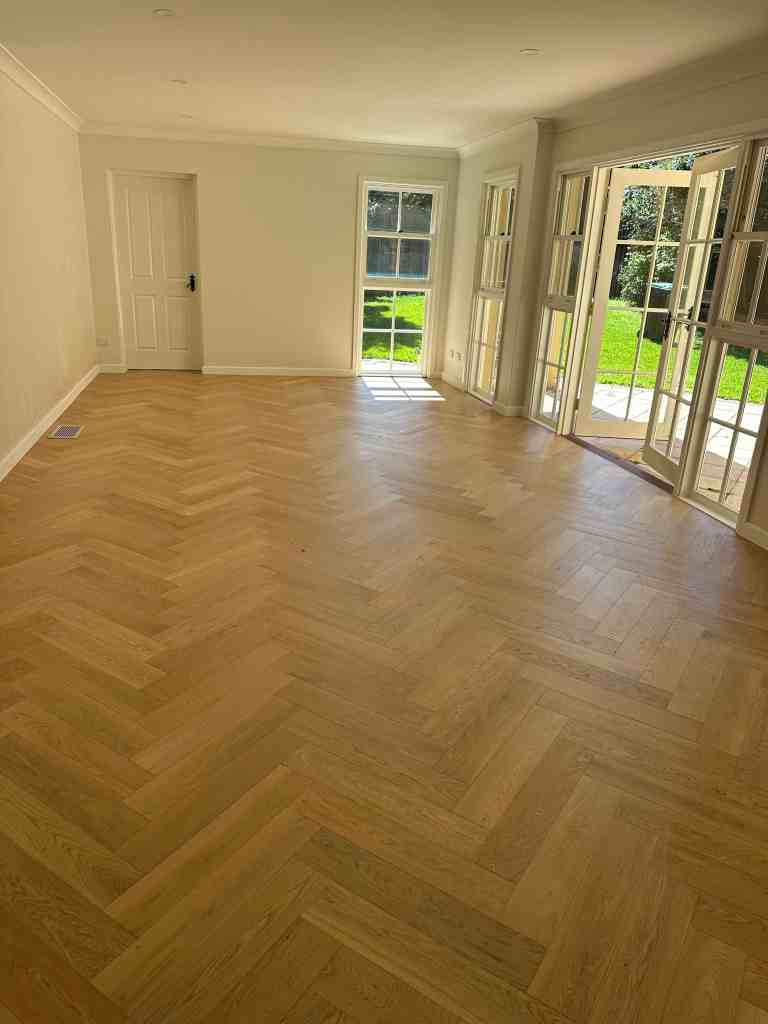
For homeowners investing in high-quality European Oak, Australian Blackbutt, Spotted Gum or herringbone engineered timber flooring, direct stick installation is often worth considering.
At Floorplan Studio, we generally recommend direct stick installation for premium engineered timber flooring projects where the budget, flooring specifications and subfloor conditions allow.
However, the final recommendation should always be based on an assessment of the individual property.
Sometimes the most economical solution is not the one with the lowest installation rate, but the one that provides the best overall balance between subfloor preparation, installation costs and long-term flooring performance.
If you are still deciding between different flooring materials, you can also read our flooring selection guide to better understand the differences between engineered timber, laminate, hybrid and other flooring options.
7. Professional Engineered Timber Flooring Installation in Sydney
At Floorplan Studio, we believe that a successful flooring project starts with understanding the property, the subfloor and the homeowner’s expectations.
As a member of the Australasian Timber Flooring Association (ATFA), we provide professional flooring supply and installation services, with particular attention to subfloor preparation, moisture management, adhesive systems and finishing details.
Our flooring showroom is located in Thornleigh, and we provide residential and commercial flooring services across Sydney, including:
-
Wahroonga and Turramurra
-
Sydney’s Upper North Shore
-
The Hills District and surrounding suburbs
Whether you are renovating an older home, building a new property or upgrading the flooring in your apartment, our team can help you assess your subfloor conditions and select the most suitable engineered timber flooring installation method.
We supply and install engineered timber flooring, laminate flooring, hybrid flooring, vinyl flooring and carpet.
If you are searching for professional flooring installation near you in Sydney, visit our Thornleigh showroom or contact Floorplan Studio to discuss your next flooring project.
Now that you understand the advantages and disadvantages of both installation methods, which would you choose for your engineered timber flooring — floating or direct stick?