Can engineered timber flooring really be waterproof?
Yes, you read that correctly.
We all know that SPC, commonly known as hybrid flooring, can be waterproof. These days, we also frequently see laminate flooring products advertised as waterproof, sometimes with labels claiming 24-hour, 48-hour or even 72-hour water resistance.
But what about engineered timber flooring?
Natural timber has always had a reputation for being sensitive to moisture. Timber absorbs water, expands and contracts, and can suffer permanent damage when exposed to excessive moisture.
So how can a flooring product made with real timber possibly be waterproof?
The answer is more interesting than you might expect.
At Floorplan Studio, we decided to investigate this question by looking at how different flooring products achieve water resistance, and more importantly, by conducting our own practical waterproof flooring experiment.
The results surprised us.
What Does Waterproof Flooring Actually Mean?
Before discussing waterproof engineered timber flooring, we need to understand something important:
Not all waterproof flooring products achieve their water resistance in the same way.
Different flooring materials use different technologies to prevent water damage.
Let’s compare three popular types of flooring commonly used in Sydney homes.
1. Hybrid Flooring: Water Resistance Through Its Core Material
Hybrid flooring, particularly Stone Plastic Composite (SPC) flooring, is widely recognised for its waterproof properties.
SPC flooring is manufactured using a composite core containing PVC and mineral fillers, which has very low water absorption and excellent dimensional stability when exposed to moisture.
In simple terms, the material itself does not readily absorb water or swell.
This is why hybrid flooring is often recommended for kitchens, living areas and other residential spaces where accidental spills may occur.
However, even when the flooring boards themselves are waterproof, this does not necessarily mean the entire installed flooring system is watertight.
Water may still find its way underneath the flooring through perimeter gaps or other openings.
2. Laminate Flooring: Preventing Water from Entering the Joints
Water-resistant laminate flooring works somewhat differently.
Traditional laminate flooring contains a wood-based core, usually high-density fibreboard (HDF), which can swell when exposed to excessive moisture.
To improve water resistance, manufacturers have developed several technologies.
These include more precise locking systems, tighter board joints, water-repellent treatments and improved core materials.
Some manufacturers also apply wax or other protective treatments around the locking profiles.
The idea is relatively simple.
If water remains on the surface and cannot easily penetrate the joints, the underlying core is much less likely to become damaged.
This is one of the reasons why some laminate flooring products are advertised with specific surface water resistance periods, such as 24 or 72 hours.
These claims are generally based on particular testing conditions, rather than a guarantee that the flooring can survive unlimited water exposure.
3. Engineered Timber Flooring: Can the Same Principle Work?
Interestingly, some waterproof engineered timber flooring products use a similar approach to water-resistant laminate flooring.
Manufacturers use precision machining to create tight-fitting tongue-and-groove or locking systems that reduce the possibility of water penetrating through the joints.
However, engineered timber presents another challenge.
Unlike laminate flooring, which has a manufactured decorative and protective surface, engineered timber flooring has a genuine timber veneer.
And real timber is naturally capable of absorbing moisture.
To address this, manufacturers may apply multiple layers of specialised protective coatings to reduce water penetration through the timber surface.
By combining a highly water-resistant surface coating with precisely manufactured joints, engineered timber flooring can achieve impressive resistance to surface water.
But there is an obvious question.
Doesn’t this mean the flooring is only waterproof from the top?
The Limitation of Waterproof Engineered Timber Flooring
Imagine a room installed with waterproof engineered timber flooring.
You accidentally spill a glass of water in the middle of the room. The water stays on the surface, and the flooring remains unaffected.
So far, so good.
But what happens if water enters from the edges of the room?
During installation, floorboards around the perimeter are usually cut to fit the walls and other fixed structures.
These cut edges may not have the same protective coating as the factory-finished surface.
If water enters underneath the skirting boards and reaches the underside or exposed edges of the timber flooring, the surface waterproofing technology may no longer be sufficient.
This is a genuine limitation of surface-water-resistant timber flooring.
Fortunately, some manufacturers have developed installation methods to address this issue.
Can Silicone Make Engineered Timber Flooring More Waterproof?
When reviewing installation guidelines for certain water-resistant engineered timber flooring products, we found that some manufacturers recommend additional perimeter sealing.
Depending on the specific flooring system, this may involve applying approved flexible waterproof sealants, such as silicone, around the perimeter expansion gaps.
After installing the skirting boards, an additional silicone seal can be applied along the bottom of the skirting.
The purpose is to reduce the chance of water entering underneath the flooring from the edges.
In principle, this is somewhat similar to sealing the perimeter of a tiled floor.
Of course, the installation method must follow the flooring manufacturer’s instructions, particularly regarding expansion allowances and compatible sealing materials.
At this point, waterproof engineered timber flooring begins to sound much less mysterious.
But does it actually work?
We decided to find out.
Our Waterproof Engineered Timber Flooring Experiment
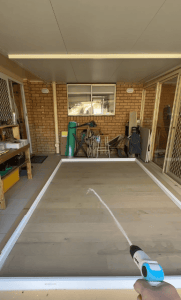
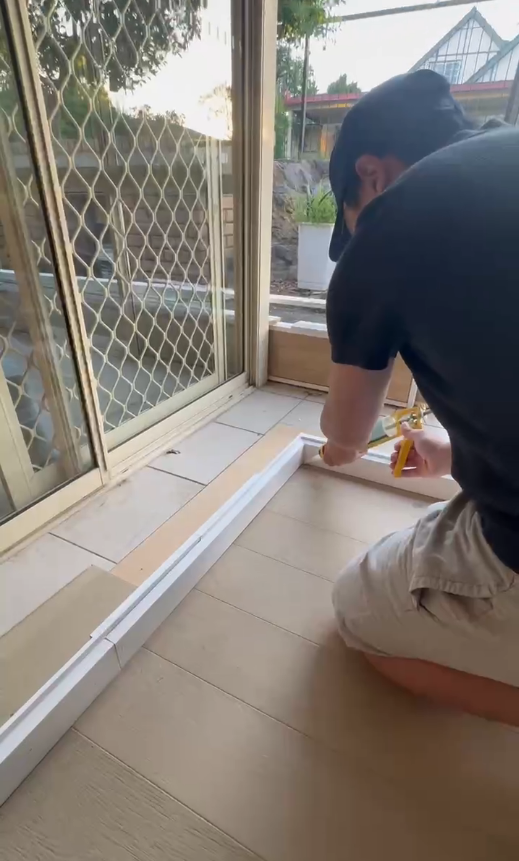
At Floorplan Studio, we constructed a test flooring area measuring approximately 3 metres by 2 metres.
We installed a type of engineered timber flooring marketed as waterproof, following the perimeter sealing approach described above.
The expansion gaps were sealed with silicone, skirting boards were installed, and another silicone seal was applied along the bottom of the skirting.
This created an enclosed flooring test area where we could investigate how the system responded to different levels of water exposure.
We conducted three tests, gradually increasing the amount of water.
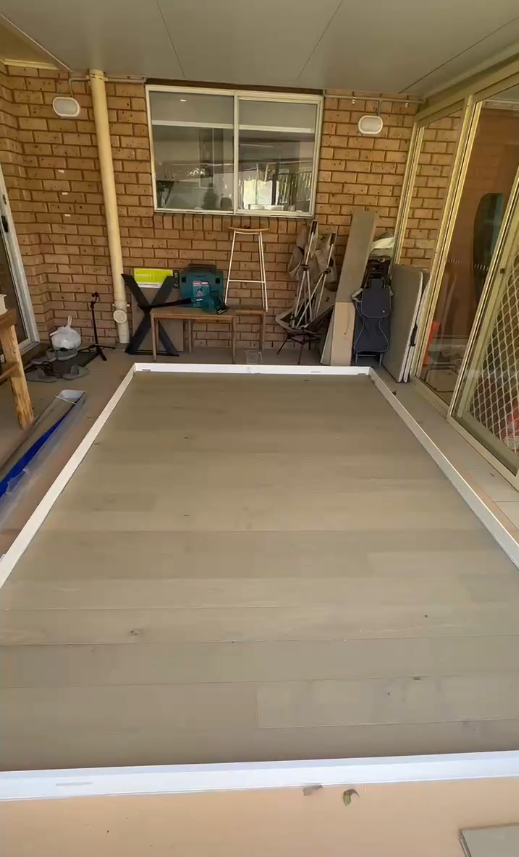
Test 1: A Glass of Water on the Floor
Our first test was straightforward.
We poured a glass of water directly onto the centre of the engineered timber flooring.
The water remained on the surface without any visible signs of penetration.
There was no noticeable swelling, movement or damage.
Result: PASS
This was not particularly surprising.
After all, if a flooring product marketed as waterproof cannot withstand a simple water spill, the claim would have very little practical meaning.
So we moved on to something more challenging.

Test 2: Covering the Entire Floor with Water
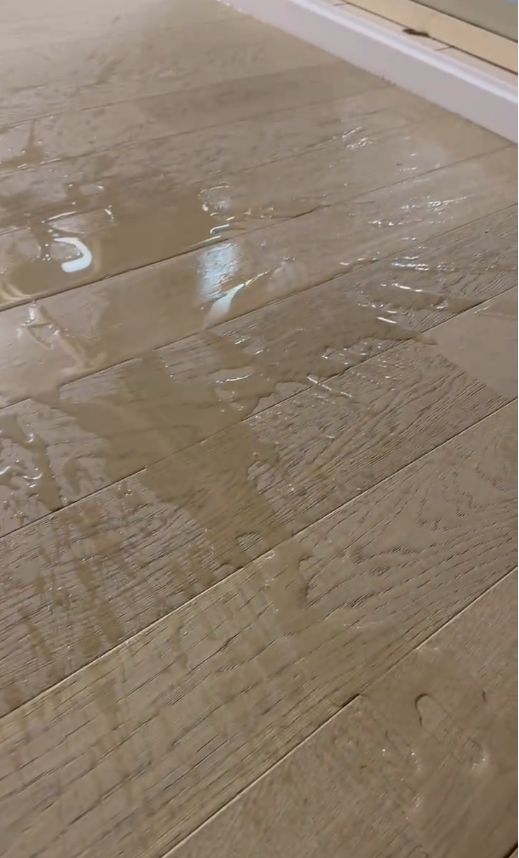
For our second test, we sprayed water across the entire 3m × 2m flooring area.
Instead of wiping it dry immediately, we left the water on the surface overnight.
By the following morning, the surface water had dried.
We walked across the flooring and checked for noticeable changes.
There were no obvious signs of swelling, cupping, buckling or unusual movement underfoot.
The flooring appeared to be performing normally.
Result: PASS
This was a much more meaningful result.
In everyday residential use, accidental water exposure is relatively common.
Someone might spill a large drink, children might splash water across the floor, or excessive water might be left behind during cleaning.
Based on our observations, this engineered timber flooring demonstrated excellent resistance to this type of surface moisture exposure.
But we wanted to take the experiment even further.
Test 3: Turning the Floor into a Swimming Pool
For our final test, we decided to do something extreme.
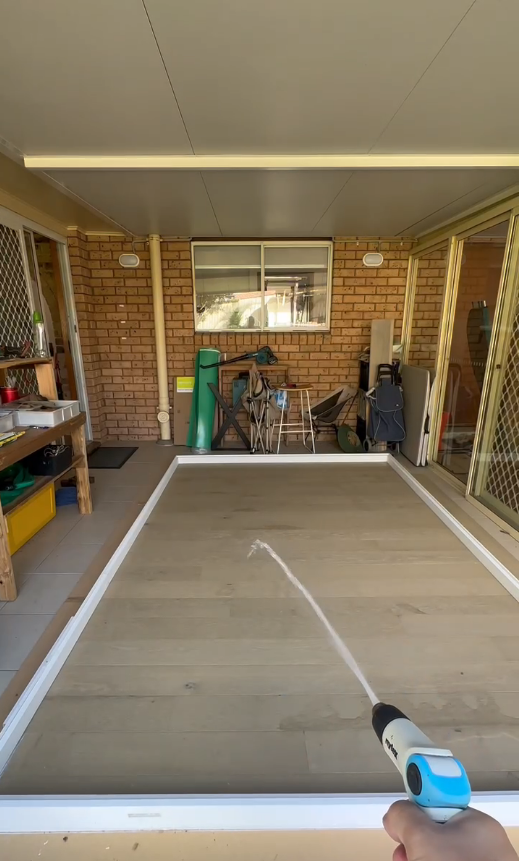
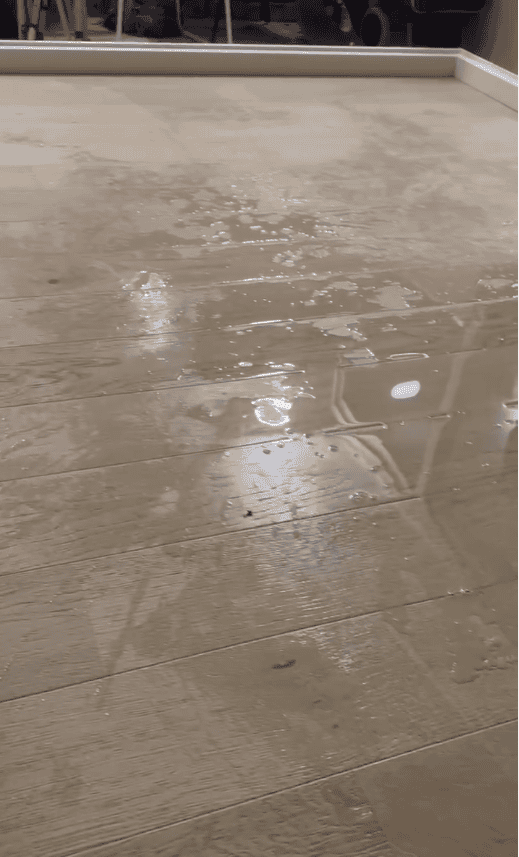
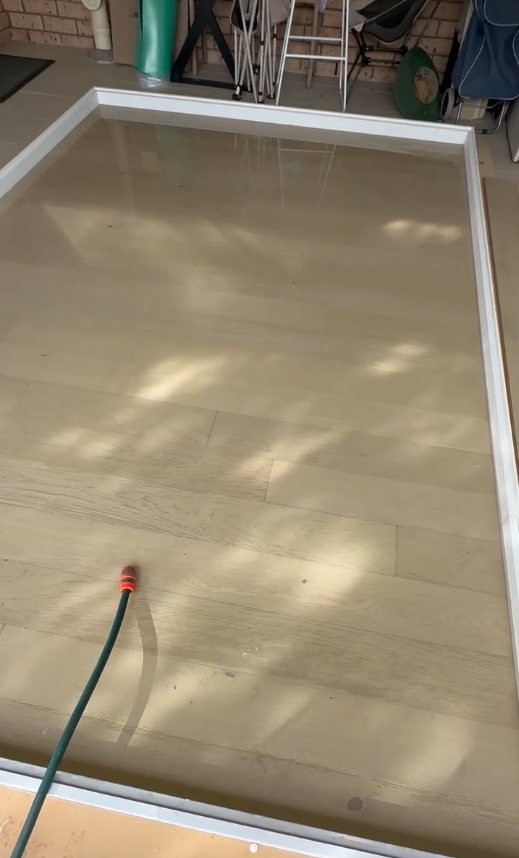
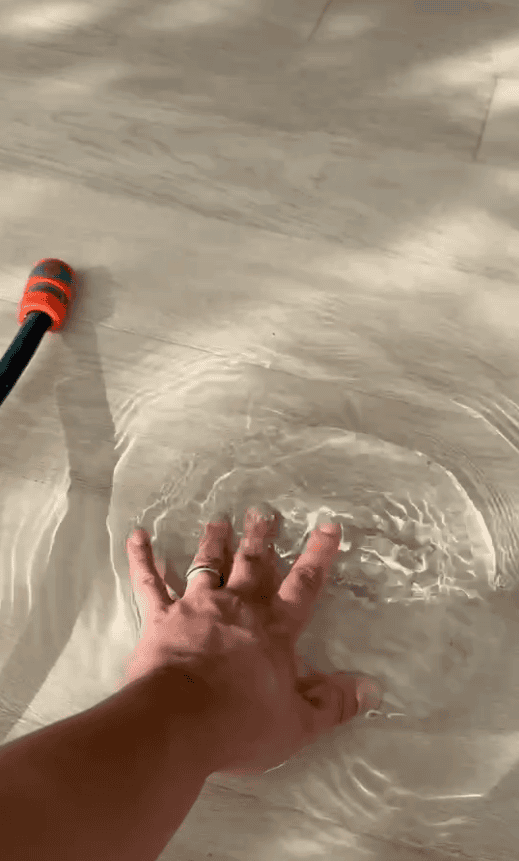
Instead of simply wetting the flooring surface, we poured enough water into the enclosed area to turn it into a shallow pool.
Essentially, we attempted to flood our engineered timber flooring test area.
And this is where things became interesting.
During the test, some sections of the perimeter silicone seal failed.
Water began escaping through the edges.
This was not the result we had intended, but it highlighted something important.
In real installations, silicone seals can also fail due to imperfect application, movement, adhesion issues or deterioration over time.
After the water had drained away, we walked across the flooring again.
Surprisingly, the flooring still felt almost completely normal underfoot.
But we wanted to know what had happened underneath.
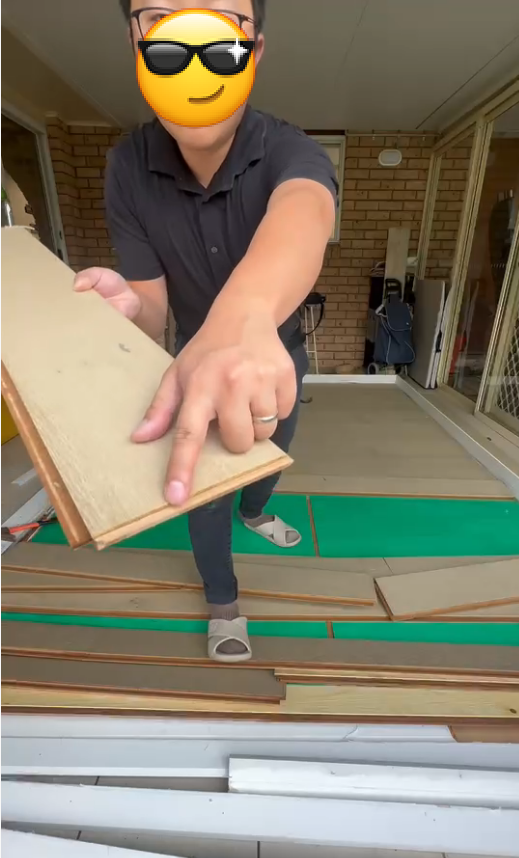
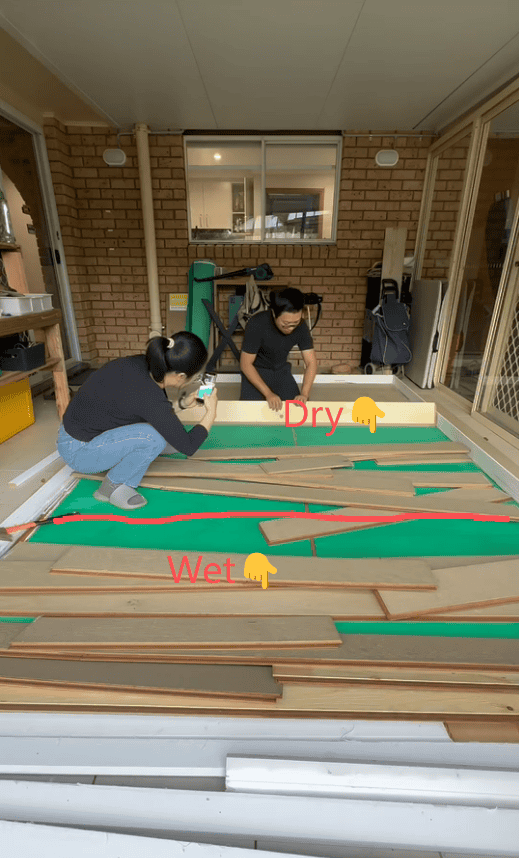
So we dismantled the flooring and inspected the boards and subfloor.
What Did We Find Underneath the Flooring?
The results were particularly interesting.
In areas where the perimeter silicone had failed, we found moisture underneath the flooring.
This confirmed that water had entered through the failed perimeter seals.
From the perspective of creating a completely watertight flooring system, our third test had failed.
However, we also discovered two encouraging things.
First, underneath most of the flooring area, the subfloor remained dry.
Second, even in areas where the perimeter silicone had failed, the flooring joints we inspected showed no obvious signs of water penetration.
In other words, while the perimeter sealing system had failed in certain locations, the engineered timber flooring joints themselves appeared to have performed remarkably well.
This was perhaps the most interesting finding of the entire experiment.
Although the flooding test was not a complete success, it demonstrated the potential of modern engineered timber flooring to resist water penetration through its surface and joints.
So, Is Engineered Timber Flooring Really Waterproof?
The answer depends on how we define waterproof.
If waterproof means a flooring product can survive unlimited flooding, prolonged submersion or continuous moisture exposure without damage, our experiment certainly does not establish that.
But if waterproof means a flooring product can withstand everyday spills, surface moisture and temporary standing water under appropriate conditions, then the engineered timber flooring we tested demonstrated very impressive performance.
And in reality, most homeowners are much more likely to encounter the conditions in our first two tests than the extreme flooding scenario in our third test.
It is also important to understand that our experiment was a practical demonstration, not a standardised laboratory waterproofing test.
Different engineered timber products, surface coatings, joint designs and installation methods may produce very different results.
The long-term effects of moisture exposure also require consideration, even when no immediate damage is visible.
Nevertheless, our experiment suggests that engineered timber flooring and water resistance are no longer necessarily contradictory concepts.
Waterproof Engineered Timber vs Hybrid vs Laminate Flooring
So which flooring option should you choose for your home?
There is no single answer.
Hybrid flooring offers excellent resistance to water absorption through its core material. It is a practical choice for many residential applications where moisture resistance is a priority.
Water-resistant laminate flooring combines a durable surface with advanced joint protection. It is often an excellent choice for busy households looking for durability, attractive timber designs and value for money.
Water-resistant engineered timber flooring offers something different: the natural appearance and texture of genuine timber, combined with improved resistance to everyday surface moisture.
For homeowners who appreciate the warmth and character of real timber but have concerns about accidental water exposure, this technology is particularly interesting.
However, water resistance is only one consideration when selecting flooring.
Subfloor conditions, installation methods, acoustic requirements, maintenance expectations and overall project costs are equally important.
A properly selected and installed flooring system is just as important as the product itself.
Looking for Engineered Timber Flooring in Sydney?
At Floorplan Studio, we supply and install engineered timber, laminate, hybrid flooring and carpet across Sydney.
Our approach is to help customers understand not only how flooring looks, but also how different products perform in real homes.
We regularly assist homeowners with flooring selection, subfloor preparation, installation methods and practical considerations such as water resistance and long-term durability.
Our flooring showroom is located in Thornleigh, and we provide flooring installation services across Sydney’s Northern Suburbs, Upper North Shore and Hills District, including:
-
Castle Hill – Engineered timber, hybrid and laminate flooring supply and installation.
-
Hornsby – Timber flooring, carpet and professional flooring installation.
-
Epping – Residential flooring solutions, including engineered timber and laminate flooring.
Whether you are renovating an existing home or selecting flooring for a new property, you are welcome to visit our Thornleigh showroom to explore different flooring options and discuss your project.
Our Final Thoughts
Before conducting this experiment, many people might have dismissed the idea of waterproof engineered timber flooring altogether.
After seeing the results, we think the technology deserves serious consideration.
The third test was particularly revealing.
Although the silicone perimeter seal failed in some locations, the flooring joints themselves showed impressive resistance to water penetration.
It also reminded us that waterproofing is not simply a property of an individual floorboard. It often depends on how the entire flooring system is designed and installed.
Personally, based on what we observed, I would be comfortable describing this particular product as waterproof engineered timber flooring for normal residential surface-water exposure, provided its limitations and installation requirements are properly understood.
Of course, that does not mean every engineered timber floor is waterproof, or that any timber floor should be treated as a substitute for a proper waterproofing membrane.
But it does suggest that engineered timber flooring has come a long way.
What do you think? Would you consider installing waterproof engineered timber flooring in your home?
This experiment was conducted by Floorplan Studio as a practical demonstration of a specific flooring system. Results should not be interpreted as a universal performance guarantee for all engineered timber flooring products.